
Blockchain, Cryptocurrency, and Artificial Intelligence just seem to go so well together.
The public release of ChatGPT in late 2022 and GPT4 in March 2023 sparked massive interest in the overlap between artificial intelligence and blockchain technology.
The catch? Plenty of tokens slap “AI” on the label and do nothing with it. So I’ve stuck to projects where AI is actually part of the product.
Let’s check out the top AI crypto projects that actually use AI!
Not financial advice. This article is provided for informational and entertainment purposes only. It is not intended to be, nor does it constitute, any form of financial advice or recommendations to buy, sell, or hold any investments or financial instruments, including cryptocurrencies.
What Are the Best AI Crypto Projects in 2026?
The best blockchain projects built around artificial intelligence in 2026 are:
- 1. Bittensor
- 2. The Graph
- 3. Akash Network
- 4. SingularityNET
- 5. Render
- 6. Numerai
- 7. Fetch.ai
- 8. Ocean Protocol
- 9. Clore.ai
- 10. Arkham
SingularityNET and Fetch.ai now share one token (FET) through the Artificial Superintelligence Alliance, and Ocean Protocol was part of it until October 2025. More on that below.
1. Bittensor
- Bittensor ($TAO)
- Decentralized AI Network
How Does Bittensor Use AI?
Bittensor is a decentralized machine intelligence network aiming to change the way machine intelligence is built and owned.
Instead of one company training one model, Bittensor is split into independent subnets. Each subnet produces its own digital commodity, from compute and data storage to AI agents and even deepfake detection, and the network pays the people doing the work in TAO. There were 129 active subnets by December 2025 (The Block).
By rewarding whoever produces the best results, Bittensor takes a bottom-up approach to intelligence creation. It’s still my top AI crypto project pick.
What is the Use Case for the TAO Token?
TAO is how Bittensor pays for work: the chain rewards subnet miners and validators in TAO, and holders can stake it (Bittensor).
TAO’s issuance halves on a schedule, Bitcoin-style. The first halving, in December 2025, cut new TAO from 7,200 to 3,600 a day (The Block).
Why Does Bittensor Matter?
Bittensor matters because it’s the biggest live test of whether an open network can build useful AI outside the big tech labs.
By offering an open platform for machine intelligence, it challenges centralized tech giants, rewards innovation, and spreads AI’s benefits more widely. Whether subnet outputs win real paying customers is the big open question.
2. The Graph

- The Graph ($GRT)
- Data Indexing and Querying
How Does The Graph Use AI?
The Graph is a decentralized protocol that indexes blockchain data and serves it to apps through open APIs called subgraphs.
Its AI angle is that AI assistants can now use that data directly. The Graph’s official Subgraph MCP server lets assistants like Claude, Cursor and Cline find subgraphs and query them from plain-English prompts, no GraphQL required (The Graph docs).
Behind the scenes, Indexers can also use the open-source Allocation Optimizer, a set of agents and algorithms for deciding where to allocate their stake.
What is the Use Case for the GRT Token?
The use case for The Graph token (GRT) includes paying for querying data on the network, incentivizing protocol participants like Indexers, Curators, and Delegators, and steering the protocol’s governance and economic mechanisms.
Why Does The Graph Matter?
The Graph matters because AI agents need reliable onchain data, and The Graph is already one of the main ways apps get it.
If agents become big users of blockchain data, a protocol that serves it quickly and cheaply, without one company in the middle, is well placed to serve them.
3. Akash Network
- Akash Network ($AKT)
- Decentralized Cloud Computing
How Does Akash Use AI?
Akash Network is an open-source, decentralized cloud marketplace.
You choose the GPU model, region and maximum price you want, independent providers bid for the job in a reverse auction, and you accept the best offer (Akash). That gives AI developers cost-effective, scalable computing for training and running models.
Akash also runs AkashML, a hosted service for running open-source AI models through OpenAI-compatible APIs, so you don’t have to manage any infrastructure yourself.
What is the Use Case for the AKT Token?
AKT settles the network’s compute auctions, secures the network through staking, and gives holders a vote on upgrades.
Under Akash’s burn-mint system (AEP-76), deployments mint stable internal credits by burning AKT, which ties the token directly to demand for compute (Akash).
Why Does Akash Matter?
Akash matters because GPUs are the bottleneck in AI, and it gives developers a way to rent them from independent providers instead of a handful of big cloud companies.
Its decentralized marketplace addresses the growing demand for transparent, affordable cloud computing, and it’s one of the best-known names in the AI crypto space.
4. SingularityNET
- SingularityNET (AGIX, now merged into FET)
- Decentralized AI Platform
How Does SingularityNET Use AI?
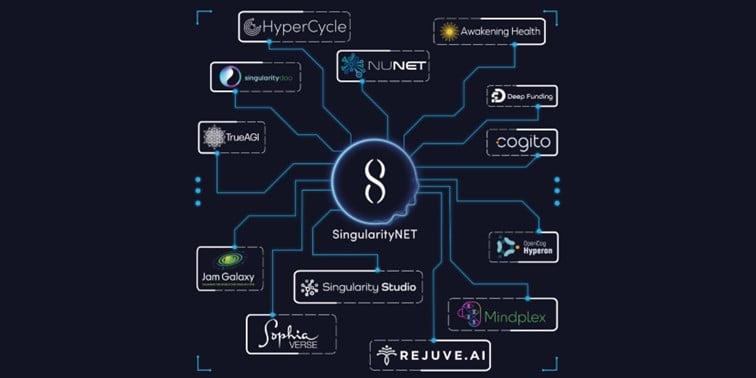
SingularityNET is a decentralized platform aiming to bring artificial intelligence and blockchain together.
It addresses AI fragmentation and monopolization by enabling developers to launch, interoperate, and monetize AI tools and AI based projects through its marketplace, fostering a collaborative and open AI ecosystem.
In 2024, SingularityNET teamed up with Fetch.ai and Ocean Protocol to form the Artificial Superintelligence (ASI) Alliance. The alliance now unites Fetch.ai, SingularityNET and CUDOS (ASI Alliance).
What Happened to the AGIX Token?
AGIX was merged into Fetch.ai’s FET token from July 2024, at a fixed rate of 0.433350 FET per AGIX (Fetch.ai).
FET is now the shared token of the ASI Alliance. The plan is to rename it ASI, but that final step is still pending, so it still trades as FET (ASI Alliance).
Why Does SingularityNET Matter?
SingularityNET matters because it’s trying to build artificial general intelligence in the open, rather than inside a big tech lab.
Pooling resources with Fetch.ai and CUDOS gives it more scale, though the alliance has had its share of drama (see Ocean Protocol below).
5. Render

- Render Network ($RENDER)
- Decentralized GPU Rendering
How Does the Render Network Use AI?
Render uses blockchain technology to connect people who need GPU rendering with people who have idle GPU power.
It is one of the more popular crypto AI projects, distributing and managing rendering jobs to make high-quality, photorealistic image production accessible and cost-effective for industries like film, gaming, and architecture. It also plugs generative AI tools from Runway, Black Forest Labs, Luma Labs and Stability AI into the network (Render Network).
The team behind Render has also launched Dispersed, a decentralized GPU network aimed squarely at AI work like inference, training, and image and video generation.
What is the Use Case for the RENDER Token?
The RENDER token powers transactions within the Render Network, linking those in need of rendering power with owners of idle GPUs or GPU farms.
The network moved from Ethereum to Solana in November 2023, when the old RNDR token became RENDER (CoinJar).
Why Does Render Matter?
Render matters because it turns idle GPUs into useful rendering and AI capacity, a bit like GPU mining but for productive work.
With AI soaking up the world’s GPUs, Dispersed is Render’s bet that the same model works for AI jobs too.
6. Numerai
- Numerai ($NMR)
- Blockchain AI Hedge Fund
How Does Numerai Use AI?
Numerai runs a quantitative hedge fund powered by thousands of machine learning models built by data scientists around the world.
It gives away free, obfuscated stock market data. Data scientists build models, submit their predictions, and Numerai combines them into a single meta model that drives the fund (Numerai).
It’s not just a crypto experiment either. In August 2025, JPMorgan Asset Management committed up to $500 million to Numerai’s fund (Cointelegraph), and in November 2025 Numerai raised a $30 million Series C at a $500 million valuation (Numerai’s press release).
If you fancy having a crack at building a model, my list of the best books on AI and machine learning is a good place to start.
What is the Use Case for the NMR Token?
The NMR token, an ERC-20 cryptocurrency, lets data scientists stake on their models. Good predictions earn more NMR, while bad ones get their stake burned (Numerai).
Why Does Numerai Matter?
Numerai matters because it’s one of the few AI crypto projects with a working business behind it: a real hedge fund that big institutions have backed.
It’s also a neat model for crowdsourcing AI, paying thousands of data scientists for their best work instead of hiring them.
7. Fetch.ai
- Fetch.ai ($FET)
- Autonomous AI Agents
How Does Fetch.ai Use AI?
Fetch.ai builds autonomous AI agents that act on your behalf. It started out pitching AI “digital twins”, and that idea has grown into a full agent platform.
Its personal AI, ASI:One, learns your preferences and can coordinate multiple AI agents to handle tasks like booking flights, reserving dinners and managing your calendar. Developers can register their own agents on Agentverse, an open directory that Fetch.ai says lists 2.7 million agents (Fetch.ai).
If you’re curious how the language models behind assistants like this work, I explain the basics in what is natural language processing.
What is the Use Case for the FET Token?
FET is now the shared token of the ASI Alliance. It pays for AI services like the ASI1-mini language model, can be staked to secure the Fetch.ai network and earn rewards, is needed to register agents, and gives holders a vote on proposals (ASI Alliance).
Why Does Fetch.ai Matter?
Fetch.ai matters because AI agents are one of the biggest trends in AI, and it has been building agent infrastructure for years.
With ASI:One aimed at everyday users and Agentverse for developers, it’s an AI crypto project with a product normal people can actually try.
8. Ocean Protocol
- Ocean Protocol ($OCEAN)
- Tokenized AI & Data
How Does Ocean Protocol Use AI?
Ocean Protocol builds tools for sharing and monetizing data for AI without giving up control of it.
Its Compute-to-Data feature runs the computation where the data lives instead of moving the data, which helps keep private data private. Ocean Nodes let people contribute GPU and CPU compute, and access to data is handled through data NFTs and datatokens (Ocean Protocol).
That gives AI developers access to valuable datasets for training models, without data owners losing control.
What Happened to the OCEAN Token?
OCEAN was merged into FET in July 2024 as part of the ASI Alliance, but the Ocean Protocol Foundation left the alliance on 9 October 2025.
OCEAN now trades independently again. Holders who never converted can still swap it for FET at the original rate of 0.433226 FET per OCEAN, and Ocean has said it plans to use profits from its spin-out ventures to buy back and burn OCEAN (Bankless).
Why Does Ocean Protocol Matter?
Ocean Protocol matters because AI runs on data, and much of the most valuable data is private.
Letting AI learn from that data without it ever leaving its owner is a genuinely useful idea, whichever token it ends up running on.
9. Clore.ai
- Clore.ai ($CLORE)
- Distributed Supercomputing
How Does Clore.ai Use AI?
Clore.ai is a GPU rental marketplace built for AI work.
Hosts list their NVIDIA hardware, and renters book it on demand at a fixed price or bid for cheaper spot capacity. It’s used for things like AI training, image and video generation, and rendering. When a GPU isn’t rented, it mines crypto instead (Clore.ai).
What is the Use Case for the Clore.ai token?
CLORE is used to pay for GPU rentals on the platform.
Its Proof of Holding system gives holders extra rental rewards and discounts on fees (Clore.ai).
Why Does Clore.ai Matter?
Clore.ai matters because it’s a simple, working answer to the GPU shortage: hardware that would otherwise sit idle gets rented out for AI work.
As demand for accessible GPU computing keeps growing across AI development, gaming, and blockchain, marketplaces like Clore give smaller teams a way in.
10. Arkham
- Arkham ($ARKM)
- AI Blockchain Deanonymization
How Does Arkham Use AI?
Arkham’s intelligence platform is powered by its own AI engine, Ultra, which labels blockchain addresses and clusters them into real-world entities (Blockworks).
This process identifies the real-world entities behind blockchain activity, enabling detailed insights and analytics about their behavior.
What is the Use Case for the Arkham token?
ARKM is the currency of the Arkham Intel Exchange, an onchain marketplace where people post bounties and run auctions for blockchain intelligence.
It’s also Arkham’s governance token, and holders get rewards and fee discounts across Arkham products (Blockworks).
Why Does Arkham Matter?
Arkham matters because regulators and investors want more transparency in crypto, and Arkham’s AI-driven analytics are one of the best-known ways to get it.
The flip side is privacy: the same tools that catch hackers and track big wallets also make it much harder to stay anonymous onchain.
Wrapping Up
The integration of artificial intelligence and crypto is bringing in an exciting new era of technological innovation.
As the projects in this article show, AI crypto is moving past hype into real services: GPU marketplaces, data networks, agent platforms, and even a hedge fund.
While still early, AI crypto projects could shake up major industries through automation, predictive analytics, and optimization. It’s already reaching traditional finance too, with JPMorgan backing Numerai’s AI-driven hedge fund.
However, the biggest challenges may lie within scaling, competition, and the need for user adoption.
These tokens also carry all the risks of emerging tech and crypto combined, so do your own research. And expect more mergers, splits, and pivots like the ASI Alliance saga before this space settles down.